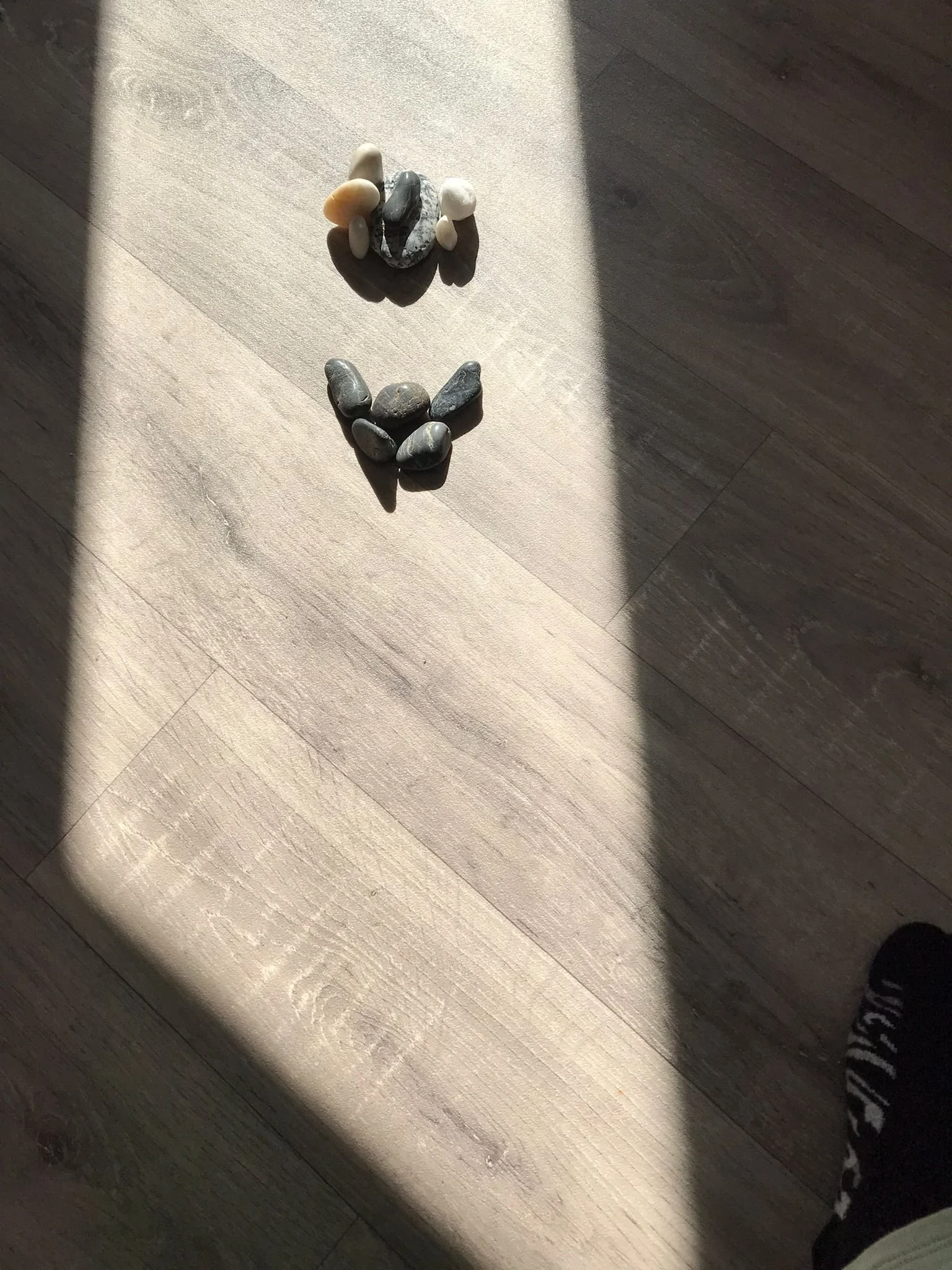
Stephen sent me the photographs that she had taken, but due to a knee injury her initial plan didn’t happen:
I couldn't get down to the beach Grace. I managed to drive to Wales, but I struggled so much because they told me to take my crutches and my brace with me, …I just didn't dare risk it because I just thought if my ankle turns or my knee…. So yeah, it was a bit sobering. I was disappointed because I've got some ideas of being a bit more creative.
I wanted to her realise this idea that she wasn’t able to execute so I offered to create the video for her. Her work is concerned with supporting people with physical limitations to heal and feel more comfortable. So as her inability to make this video was due to a physical injury, I had offered what I could to help: my creative skills, equipment, and location. Collaborative making in this instance became a creative act of care.
Stephen described her idea to recreate an experience she had witnessed often: the death of a patient in the presence of their family and loved ones. Each person would be represented by a stone. The sea became the metaphor for the place she believed the spirit or soul of the patient went after they had died, and the light played an important role too.
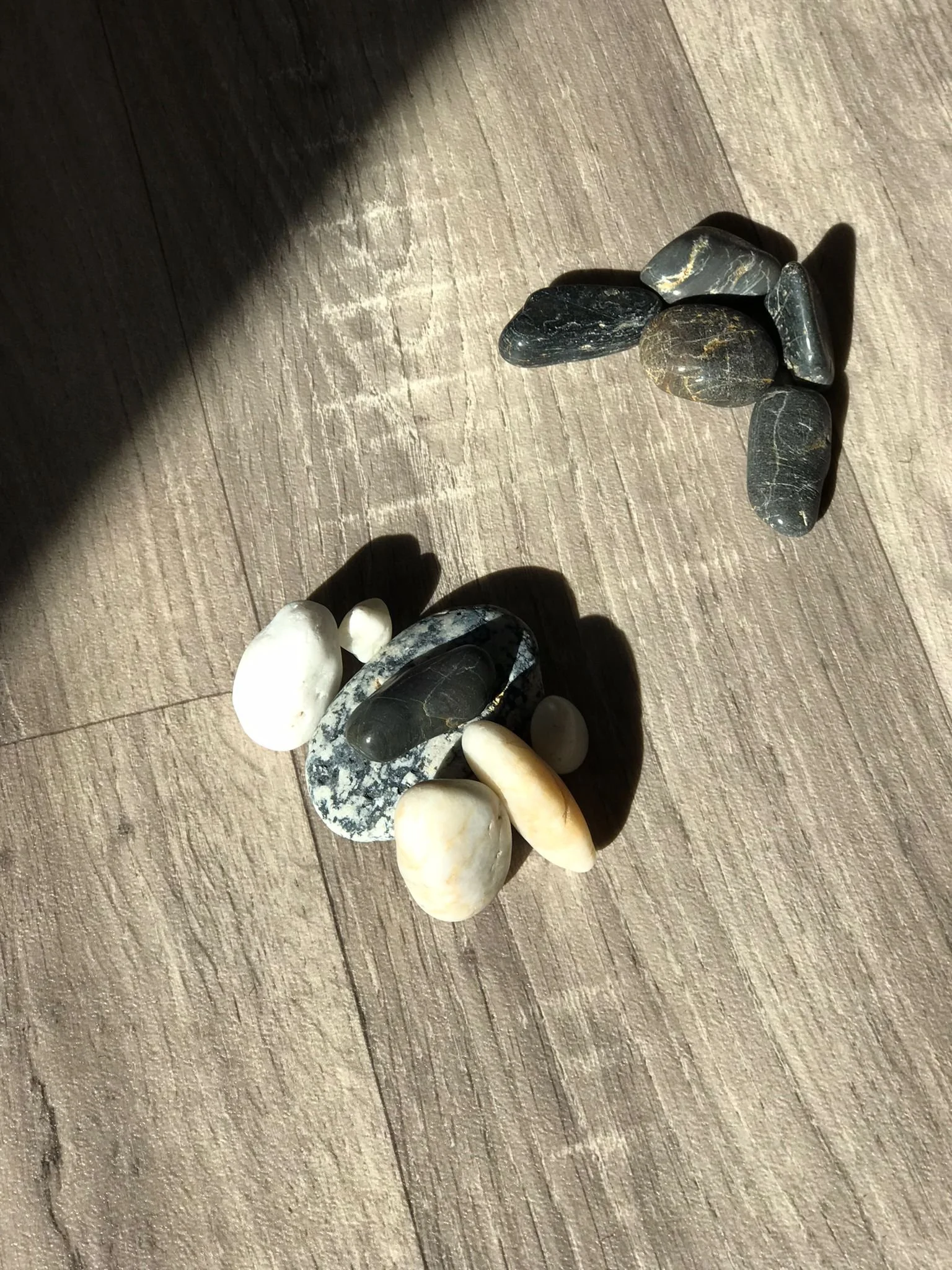
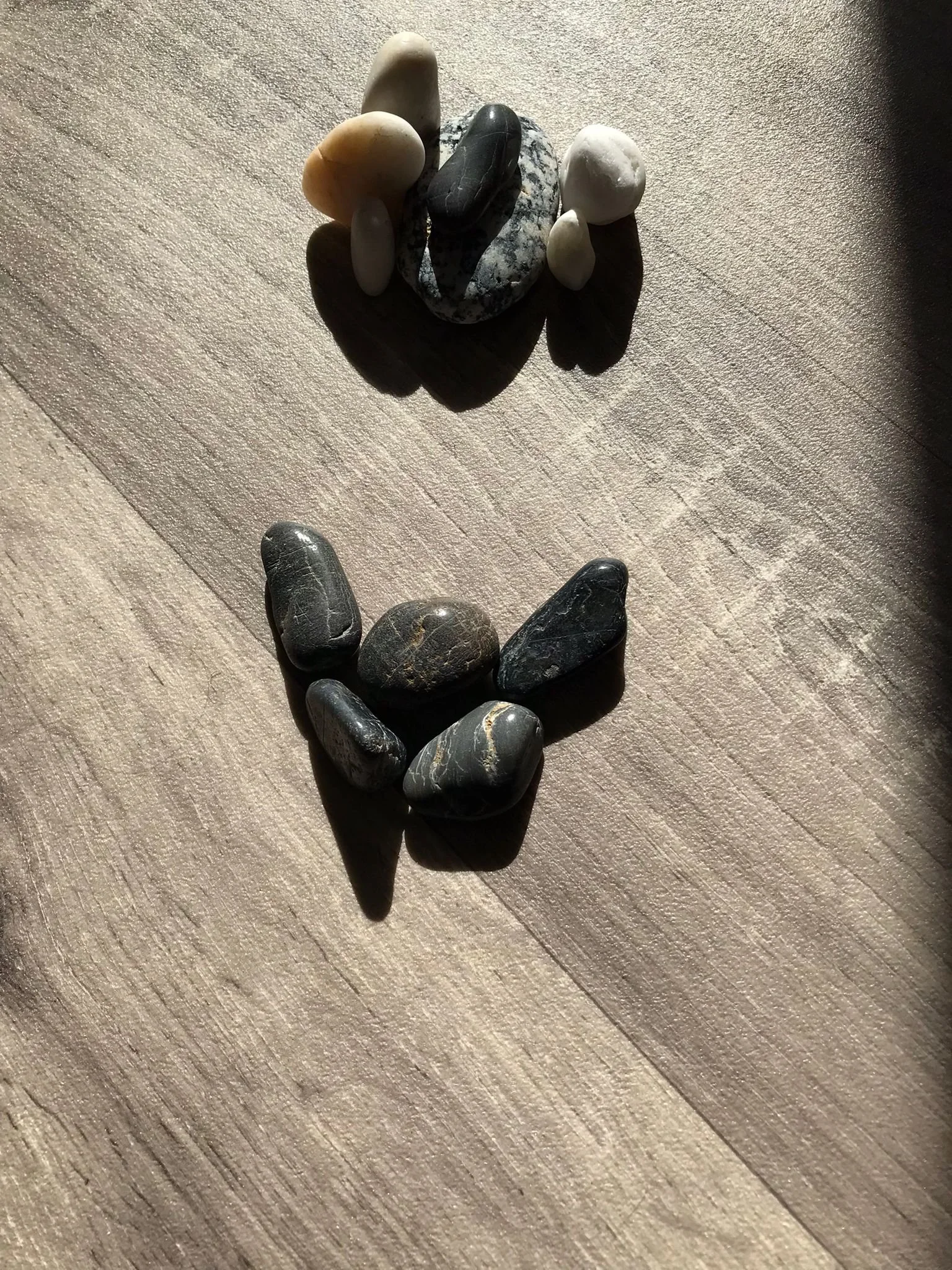
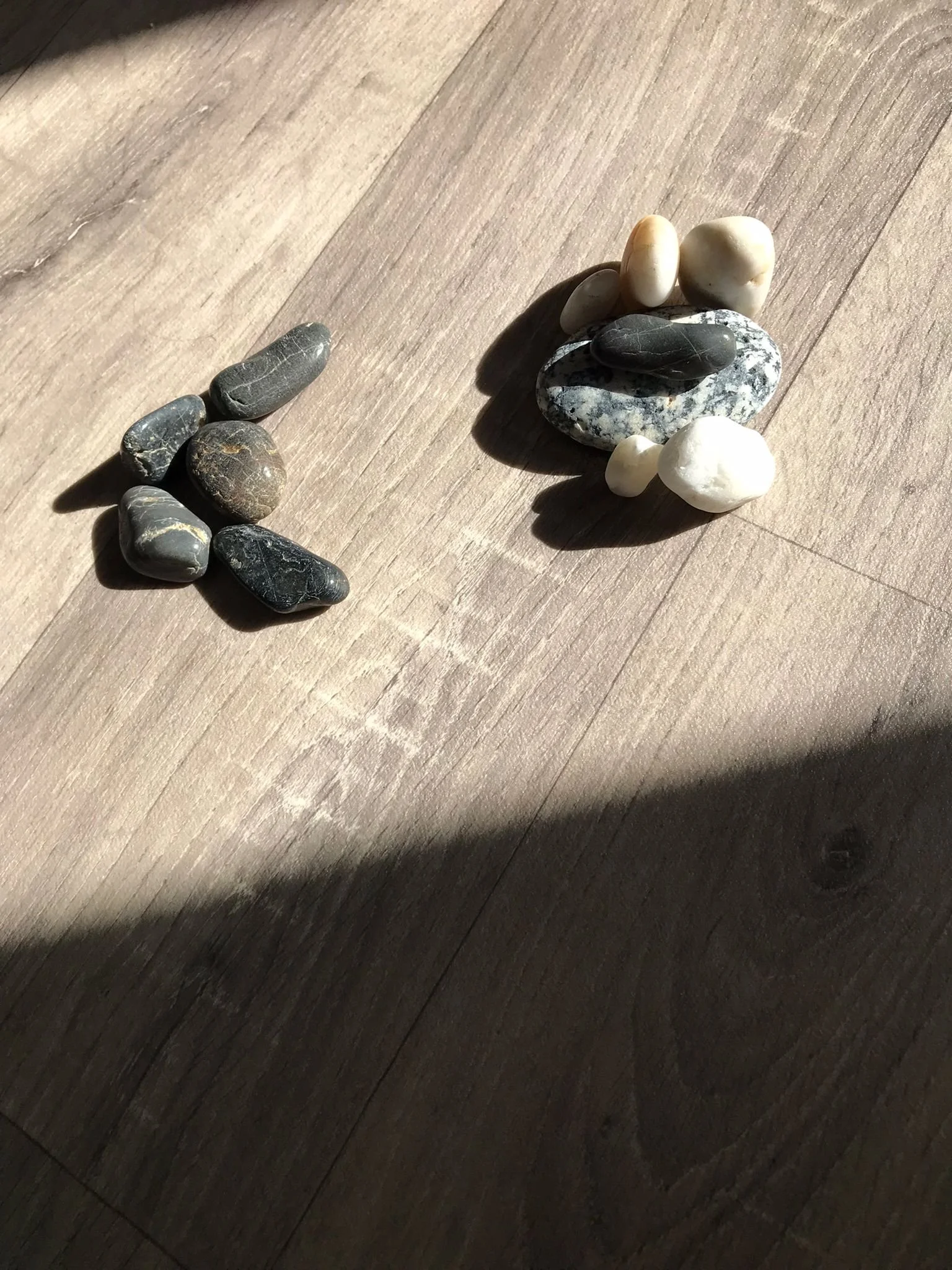
The next stage of the process was a conversation about the four photographs she had sent over, taken on her tabletop with small pebbles instead of the slate that she had originally planned to use in Wales. There was a patient in their bed, surrounded by loved ones, and further away a group of stones representing the staff, who were further back to give the family privacy. The sea would be the moving part of the piece.
These photos were aesthetically pleasing in themselves; intriguing compositions of small stones, light and shadows. She commented on how the unexpected shaft of light on the table had added depth to the scene, contributing to the elemental themes and metaphors of a place beyond death.
There was a really good patch, or a strip of sunlight and I thought how it’s a bit of a theme that has been with me, with that tunnel of light imagery. Not deliberate just when I've seen things and thought, yeah.
In the photos she had already sent, months before, there were images that she had taken through a hole in the fence, of a flower, and she had already spoken about the metaphor of a tunnel at the end of life.
When we discussed the photos she realised in that moment that they reminded her of other uses of stones:
Thinking about it, they remind me a bit of standing stone circles, which is totally irrelevant. Or, or gravestones, you know, only that was not part of my theory. Oh, God, that could be interpreted as that!
We had an amusing exchange about this, but the gravestone-likeness had evoked a response. They were far from what she wanted to communicate but the tunnel of light metaphor life worked, so she accepted it. This suggests that there was a preconceived atmosphere and an aesthetic in mind that she wanted to capture about the transition from life to death, and gravestones were not in it. I wanted to clarify what she had previously mentioned about the reason for constructing this scene on the beach:
Grace
I also remember you saying something about the sea coming in and out.
Stephen
Yeah, so in my mind's eye that is like life ebbing and flowing. (That probably sounds pretty cheesy to be fair!)
Grace
It's okay!
Stephen
I would have had the patient bit nearer the waves, so that the staff are not in the waves. Does that make sense? The sea would come in gently over or through, where the patient stones are, and then drift back out.
Grace
So, the sea should come over the stones and then go back again?
Stephen
Yeah, and it might not go over completely, the wave would just come gently around that patient section and then go with the patient's soul, spirit, whatever you want to call it. So, you would want that, in an ideal world, if we could control the sea, you would want the sea to take the patient with it when it goes back. I don't think that would happen with a stone but that would be lovely, wouldn't it?
Grace
I could maybe think of another one because if I'm going to try and do this for you on a beach, I could find a way of having an object that would get carried by the sea. Something lighter.
Stephen
Yeah, maybe like a piece of charcoal.
Grace
That looks like a stone? maybe I don't know. I'm just brainstorming now. Yeah. But we'll see. But I understand now what the metaphors exactly mean for you; that's the main thing.
I reflected on the care and attention Stephen had paid to explaining and photographing for the instructions and I felt some responsibility in ensuring that this was done as carefully as possible. She had maintained the thread that appeared throughout her contributions - finding ways to capture the rituals, atmospheres, and moments that she witnessed after the death of a patient. I waited until a moment of inspiration struck me to devote an afternoon to testing this out. I knew the filming would work best in the winter with lower light and fewer people on the beach.
After spending time with the footage, I messaged Stephen and asked her if there was any music she wanted to go with the clip. A few days later, she told me that she had spent an evening trying to choose a song and had been upset. The process had led her to re-visit the many end-of-life events that the video was based on, and this had caused the associated emotions to re-surface. This encounter suggested that the act of continuously bearing witness to patient deaths meant that the emotional toll remained. She decided not to have a song but to simply leave the sound of waves as the only audio.
After Sea Life
*Field notes
I went to the beach today, to arrange the stones as per Stephen’s (she/her) request. (Stephen originally wanted to take these photographs on her own beach holiday, but she had hurt her knee quite badly so I offered to create the image that she couldn’t). I identified a spot that had flat sand which made a good, clean background, and where the sea came and went. There was also a section of the beach that was just rocks so there would be stones to choose from in order to construct the scene.
It was about 4pm, the light was beautiful, the sea was calm and there were only a few people around. I tried one spot, then moved to a slightly more open one, so the background would just be sand, with no other stones creeping in. The tide was gentle but sand moved fast and the stones moved or got covered by the sand easily. The sea had its own timeline, and my decision-making, waiting for an aesthetically pleasing moment timeline was not the same.
Laura filmed clips of me collecting and constructing the stones, based on the images and instructions that Stephen had sent me, (below). There were many small decisions to be made as I was holding in mind Stephen’s wishes and composition, my own aesthetic preferences, and the behaviour and rhythm of the sea.
It was hard for me to not occasionally get mesmerised by the scene. Without thinking about it too carefully, the sun ended up being in the perfect place over the sea at the perfect time, to create a line of light leading out from the stones. It was stunning and the sea made different patterns on the wet sand each time. Being in filming mode meant I was looking for attractive shapes and light in the frame and there were so many I was a bit overwhelmed at how nice it all looked. Laura said the same. Both of us slipped into a focused looking state that was being constantly interrupted by the movement of the water, which created changes in the light patterns.
For Stephen, the sea represented the place that the patient’s spirit would be taken to after death, carried by the water so the fact that there was light in that direction (when facing the sea from the shore) added to the narrative that Stephen had mentioned when creating her own images
“there was a really good patch, like a strip of sunlight and I thought a bit of a theme has been with me with that kind of tunnel of light imagery, I think. Not deliberate just when I've seen things and thought yeah, it wasn't a conscious decision.”
She explained that she wanted originally to use slate, which I couldn’t find and that as she was going to be in Wales, there probably wasn’t going to be any sun, which I did find. I deliberately chose slimmer rocks than the large ones that were the most common on the beach, but they weren’t the slice-like form of slate that I knew she had in mind. The sun however, created not so much a tunnel of light, but a very beautiful strip of it and it fitted the narrative perfectly.
The main challenge became about the moment when the stone representing the patient on the bed, is carried away into the sea. There are several clips of video, showing the stone moving slightly or falling off and ending up further into the beach, it appeared very nice, but if the patient wasn’t carried away into the sunlit sea, it didn’t really make sense. Laura suggested we dig a small trough in front of the bed stone, and I tried swapping the stone for a lighter one. This combination eventually worked.