Photo Walk: Hiking with Alessandra, Breil Sur Roya 17th October 2023
Alessandra was finding it difficult to take new photographs so, as she lived in the same city as me, I proposed that we go for a hike to see if moving together might unlock some new ideas. Both walking interviews and photo walks are established research methods, explored in a range of social research projects. Ethnographer Sarah Pink describes walking as a “near universal multisensory activity”(Pink, 2015, p. 111) and she draws attention to the embodied nature of walking and thinking together in order to understand place and history. Being together and enacting the repetitive motion of walking, generated rhythm and constant change and my goal was to enable Alessandra’s creative process some space and time to see what emerged. The hike was a way to walk and talk through her experiences and find ways to visualise her feelings of moral distress without the objects she associated with them close by.
We arrived in Breil Sur Roya around 1.15pm on a Tuesday afternoon in October. It seemed from the weather forecast like it was going to be the last warm day of a long summer. I had offered to bring my camera for her to use, or for me to take photos under her direction. I also wanted to capture any impromptu moments of inspiration that might arise.
I enjoyed the way that our motion and the surrounding scenery informed the pace and speed of the conversation. How the body is involved in the processing of ideas and how the conversation is naturally paused when climbing a steep hill. With the walks taking place in a natural environment, there is always a huge range of scenery, and plants to take inspiration from.
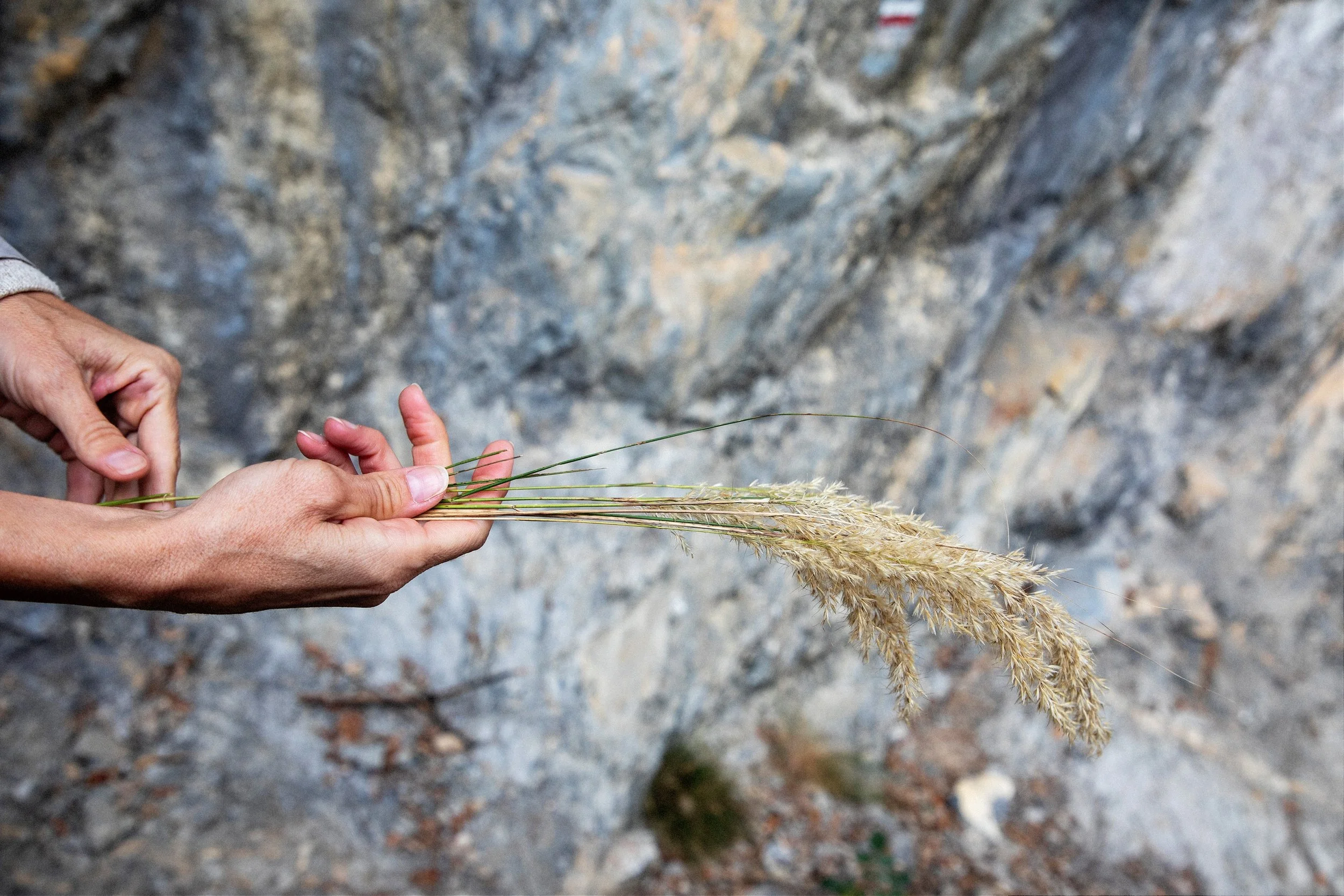
Alessandra had already told me about a photograph that she had wanted to take, but when she tried to she felt that it “didn’t work.” The photograph was of a plant that grew in her native San Diego, light bushes of thin sticks with feathery ends on them, that moved in a particular way. For her, the way this plant moved and sounded, captured an atmosphere of peace and tranquillity that could sometimes be felt when someone had died peacefully at the hospital. She also described how after a particularly traumatic event at work, she would go outside into the grounds to get some fresh air, and she would sit and run her fingers through the plant to soothe herself. She later described how the presence of that plant at the hospital meant that whenever she saw it growing in the wild, she would think about moments from work and reflect on difficult events. It made sense to me that this image was important and that her attempts to capture it were making her frustrated. One such attempt had been on her recent trip to Brussels, where she had seen the plant growing on the side of the road, but the photograph she took of it was not very “good”. I asked her if she was thinking about this project at the time, but she wasn’t she had seen the plant and realised that it linked to moral distress and then tried to take a “good photograph”. The same thing happened at the beginning of our walk.
We had started the path by the river on a short hike that I had done twice before. She was sharing how she always loved being in nature when she spotted a plant that was like the plant from San Diego (Mexican Feather Grass). I took out my camera and made a few short films as it was moving nicely in the wind. I also took a few stills, showing her after each one to check it was how she would like it to appear. She liked some of them a lot and felt that the lens had captured the details of the feathery tips better than her phone could. Soon we turned up into the pine-filled slope that led to a higher ridge above.
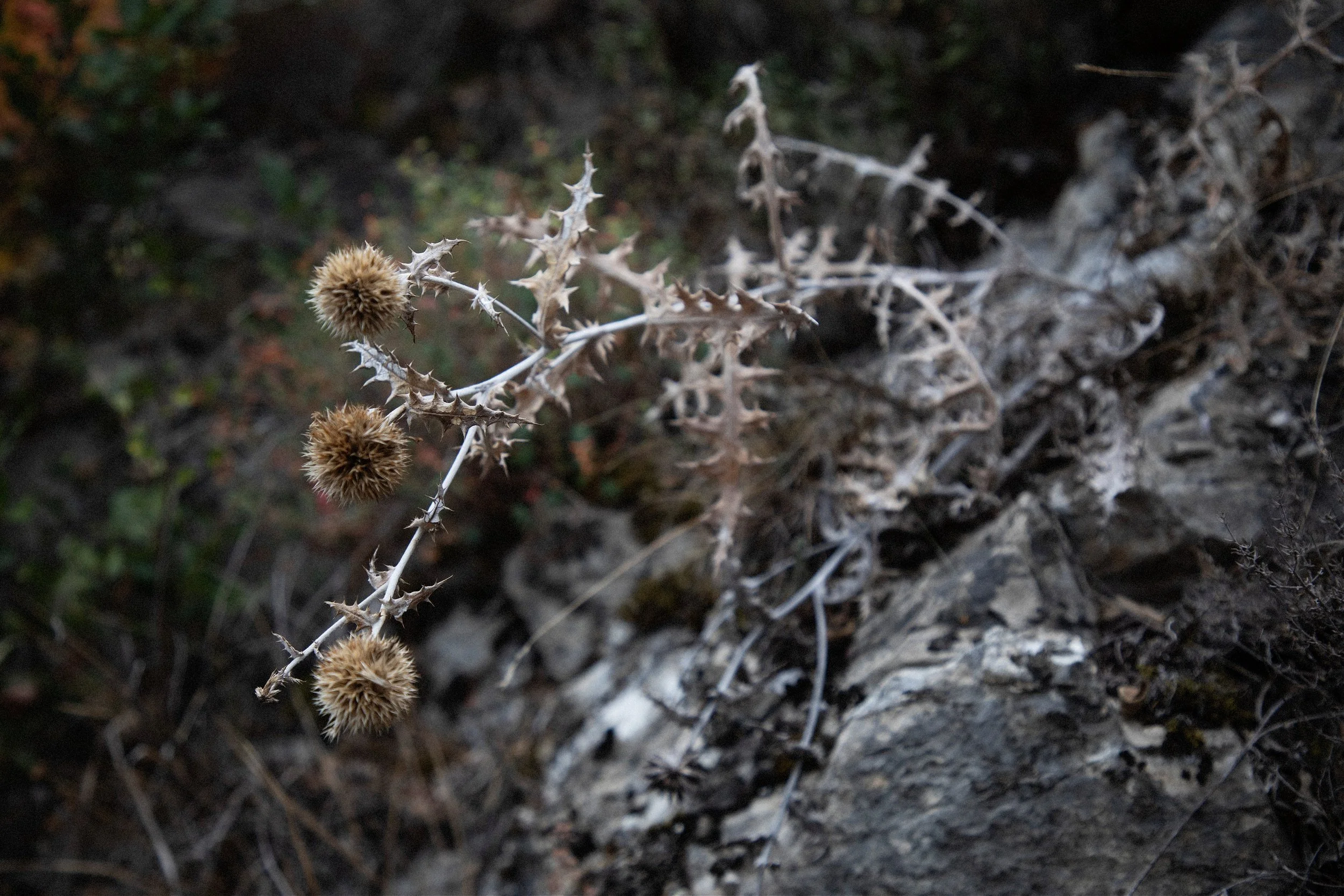
It was a 40-minute continuous climb, so talking was intermittent, breathy, and not very focused. At some point she spotted a plant that caught her attention, a white thistle that was dry and old but stood out with its shiny white colour. I took a picture for her, and she was satisfied with it. When we got to the top of the trail, the path opened out, and Alessandra spotted the exact plant that she had been talking about a short climb up the slope. I suggested she pick a few stems to use for photos. We kept going, and the path continued, curling around big rocks, and I suggested that the rocks might be a nice background for some photos.
At this point she had begun to talk about how footage from the war between Israel and Hamas that was in the headline news (it was day 12 17/10/2023) was affecting her. The evacuation order for northern Gaza from the Israeli military had created a big dilemma as it was impossible to evacuate the hospitals, many of whom were already running out of water and electricity. She told me that the staff there were sleeping at work, unable to leave vulnerable patients behind as they had a duty of care. She knew if she were a nurse there, she too would stay and be unable to abandon critically ill patients. Every time she saw the footage of bomb sites and injured civilians, she would always notice the medical workers and said it was breaking her heart. We stopped and did a few portraits with the grass, and then she held it while I made some more short video clips, she tried blowing it and shaking it, to create the motion, but the noise was unable to be captured without a good microphone. She was running her hand through the plant and remembering how that action would soothe her when she was taking her breaks at the hospital. It reminded me how touch was such an important part of her work, and she told me how she would often hold the hands of elderly patients, confessing that as well as knowing it was nice for them to have some human contact, it also soothed her during her shift. She continued to talk about the impact of seeing other healthcare workers in impossible situations, where they had to choose between their own safety and that of their patients. She became teary and it was evident that it was hard for her to switch off her empathy for the healthcare staff she had witnessed at work in an impossible situation. I asked if the pandemic had similar effects on her, as healthcare workers who were vulnerable often had to choose between their own vs their patient’s safety. But it was clear that to her an evacuation warning, with the implied threat of bombs and rockets, was a different gamble, one where the fate of the patients and the staff was much more serious.
On the train home, I gave her my camera to have a look through the photos, and she chose the ones she liked the most. One of them was the white thistle so I asked her to elaborate on why she liked it, and she laughed a little as she said quickly, without thinking “like really beautiful but dead.”
She went on to elaborate:
“It’s really nice. It's kind of like something was alive and beautiful growing before and then kind of died. And then it just kind of it stayed, left an imprint…
Death can be pretty, death can be beautiful, and you don't choose it, but it can be the means to an end, like for a lot of those like cancer patients and stuff, like death is kind of like the better way out. They're so uncomfortable. They're so unhappy. Their quality of life is shit. And there's been several times where I've held the hands of people who were dying, and they were so happy about it.” ….
The walk had led to a new series of images, mostly taken by me but meticulously directed by Alessandra. The plants she connected to added new narrative detail and texture to her testimonies about MD, offering glimpses of her personal experiences that were more intimate than before. Moving ideas through the body enabled a form of improvisation to occur that was generative and insightful.